
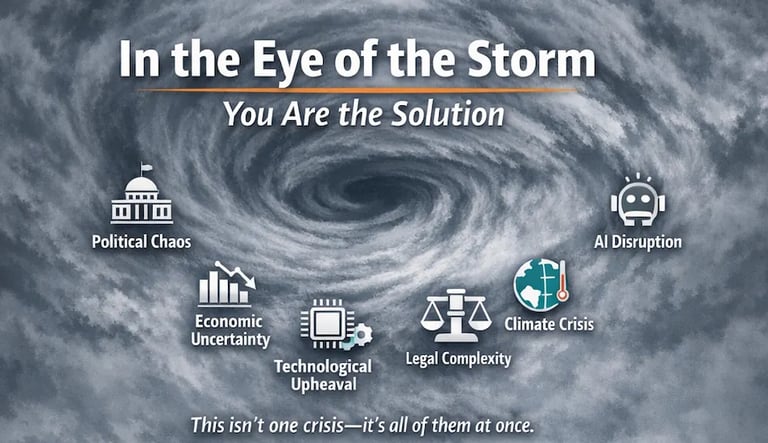
In the Eye of the Storm, You Are the Solution
4 min read
Political chaos. Economic uncertainty. Technological upheaval. And yet, you are holding the compass.
We live in interesting times.
Thanks Joseph Chamberlain.
Political systems everywhere are creaking under the strain of polarisation, trust in institutions are crumbling, and economies bend to invisible pressures — from inflationary aftershocks to AI-induced labour shifts. Add deep legal complexity, a ticking environmental time-bomb, a crisis of truth in science, and an artificial intelligence race that outpaces our ability to comprehend it — and you realise you’re right in the storm.
This isn’t just one crisis after another. It’s all of them. Right now.
But here’s the surprise. For all the noise, division, and disorientation, this is also the most opportune moment in modern history.
You are not a bystander. You are at the center. And the good news is: we already have the solutions.
The Polycrisis We Asked For
The term polycrisis — a storm of interconnected emergencies — is now part of daily discourse. The war in Ukraine reshaped global energy flows. Supply chains cracked open. Inflation spiked. Climate events are accelerating. Meanwhile, artificial intelligence has begun to rewrite the rules of work, learning, privacy, and power — faster than any regulator can blink.
None of these are root causes, they are symptoms.
The deeper truth is that we’ve allowed systems — political, economic, and social — to calcify around the priorities of the few, while disempowering the many. As philosopher Ivan Illich once warned, institutions designed to serve us have become self-preserving machines.
But the tide is turning.
The Case for Optimism
Start with energy. For decades, we knew fossil fuels were both the backbone of growth and the fuel of destruction. But solar and wind are now cheaper than coal and gas in most of the world. Battery technology is scaling. Local communities are building microgrids, reducing reliance on state-run monopolies. The solution? We already have it. It’s called decentralization.
In education, millions now learn online, from preschoolers on tablets in rural India to middle-aged factory workers retraining in AI tools on YouTube. The world’s knowledge is open-source. The solution? Democratize access and let the learner lead.
In governance, blockchain experiments and citizen assemblies are reimagining how people make decisions together — faster, fairer, and more transparently. The tools to rebuild trust in democratic processes exist. The solution? Radical transparency.
Even in AI — often framed as an existential threat — we see sparks of hope. Open-source models and local AI governance frameworks are emerging. Ethical AI isn’t a fantasy. It just needs to be prioritized. The solution? Stewardship over speed.
The Most Powerful System: Human Agency
But none of these solutions matter without a deeper recognition: that individuals, when awakened to their agency, can shift the course of history. One voice may not bend the world. But ten thousand can redirect a river. One habit may not stop emissions. But a million altered lifestyles can move markets.
Too often, people assume the world is shaped by presidents, CEOs, and billionaires. That’s partly true. But history shows that movements — civil rights, environmentalism, democracy itself — rarely begin in boardrooms. They begin in communities, classrooms, and conversations.
What you believe, what you buy, what you build, and what you share — these are not trivial choices. They are levers of transformation.
From Consumer to Creator
The old model says you are a consumer. Watch this. Vote here. Accept this policy. Click that button.
The new model says: build. Build media you trust. Build systems that serve. Build relationships that span division. Whether you are coding a new app, starting a neighborhood food co-op, or simply choosing not to repost outrage, you are shaping the future.
Consider the rise of citizen science. During COVID-19, networks of volunteers helped trace variants, gather data, and verify medical information faster than official bodies. Or take the example of regenerative farming: farmers around the world are moving away from extractive practices — not because of top-down mandates, but because communities organized, shared knowledge, and proved better results.
The pattern is clear. Leadership is emerging from below.
The Crucible of Now
We are in a crucible — a moment of immense pressure that can either shatter or forge. And make no mistake: this is not just about policy or technology. It’s about a choice of worldview.
Do we continue to live in a world designed by a handful of interests, optimized for profit and compliance? Or do we recognize this moment as a once-in-a-generation opportunity to redesign the world from the ground up?
If the latter, then the storm we face is not something to fear — but a wind to harness. In the fire of uncertainty, something new can be forged.
The Path Forward
You don’t need to have all the answers. But you do need to ask better questions. Who benefits? Who decides? What am I complicit in? What am I capable of changing?
Start small. But start. If you see the problem, say so. If you have a better model, share it. If you feel called to lead, step forward. No title required.
Yes, the storm is real. But so is your compass.
The solution is not out there, waiting for someone in a distant office to write a white paper. It’s here — within communities, creators, local leaders, and everyday people willing to think, act, and speak with clarity.
The future doesn’t arrive fully formed. It is built. Decision by decision. Day by day.
And in this storm, you are not lost.
You are the signal.
#Solutions #Politics #Economics #Social #Technology #Law #ClimateAction